
Dental Implant
Restore Your Smile with Confidence
Missing teeth can affect more than your appearance. They may make it harder to eat, speak, and maintain proper oral function. Tooth loss can also contribute to changes in the jawbone over time.
Dental implants provide a long-term, natural-looking solution for replacing missing teeth. They can be used to support dental crowns, bridges, or implant-supported dentures, helping restore the function and appearance of your smile.
What Are Dental Implants?
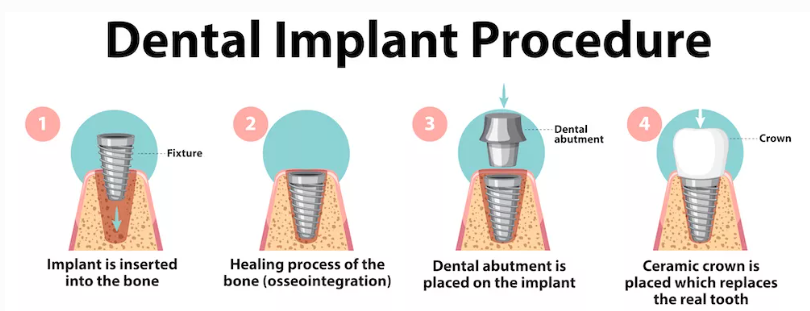
A dental implant is a small titanium post that is surgically placed into the jawbone to replace the root of a missing tooth. As the implant heals, it can integrate with the surrounding bone, creating a stable foundation for a dental restoration.
Once the implant has healed, a custom-made dental crown, bridge, or implant-supported denture can be attached to restore the appearance and function of the missing teeth.
Dental implants may be used to replace a single missing tooth, several missing teeth, or an entire arch of teeth, depending on your individual needs and oral health.
All-on-4 & All-on-6 Dental Implants
All-on-4 and All-on-6 dental implants are implant-supported treatment options for patients who are missing most or all of their teeth in an arch.
The treatment uses four or six dental implants to support a fixed full-arch restoration. The implants are strategically positioned in the jaw to provide support for a full set of replacement teeth.
Depending on your bone structure, oral health, and individual treatment needs, All-on-4 or All-on-6 dental implants may provide a stable foundation for restoring the function and appearance of an entire arch of teeth.
Your dentist will assess your teeth, gums, jawbone, and overall oral health to determine which dental implant treatment may be appropriate for you.
Why Choose Dental Implants?
✅ Long-term solution for missing teeth, whether you are missing one tooth or several
✅ Helps maintain jawbone structure by providing support similar to a natural tooth root
✅ Helps prevent nearby teeth from shifting into the space left by a missing tooth
✅ Restores chewing and speaking function
✅ Natural-looking and comfortable, designed to look and feel like natural teeth
The Dental Implant Process
The dental implant process varies from patient to patient. Not every patient will require every step, and the treatment sequence may vary depending on your oral health, jawbone condition, number of missing teeth, and individual treatment needs.
- Consultation & Treatment Planning
A comprehensive dental examination and 3D CBCT (Cone Beam Computed Tomography) imaging are used to assess your teeth, gums, and jawbone and help develop an appropriate dental implant treatment plan. - Bone Grafting (If Needed)
If there is not enough bone volume or density to support a dental implant, bone grafting may be recommended to improve the jawbone foundation before implant placement. - Sinus Lift (If Needed)
May be recommended for some upper teeth implant cases when there is insufficient bone height in the upper jaw. This procedure can help create additional bone support for dental implant placement. - Implant Placement
A titanium dental implant is surgically placed into the jawbone to replace the root of the missing tooth. - Healing & Integration
The healing time varies from patient to patient and cannot be predetermined by a fixed number of months. During the healing process, the implant gradually integrates with the surrounding bone. Your dentist will assess the healing and stability of the implant to determine when it is ready for the next stage of treatment. - Restoration
Once the implant has reached appropriate stability, the final restoration can be completed. A custom-made dental crown is fabricated and placed to restore the function and appearance of the missing tooth.
Bone Grafting: Building a Strong Foundation
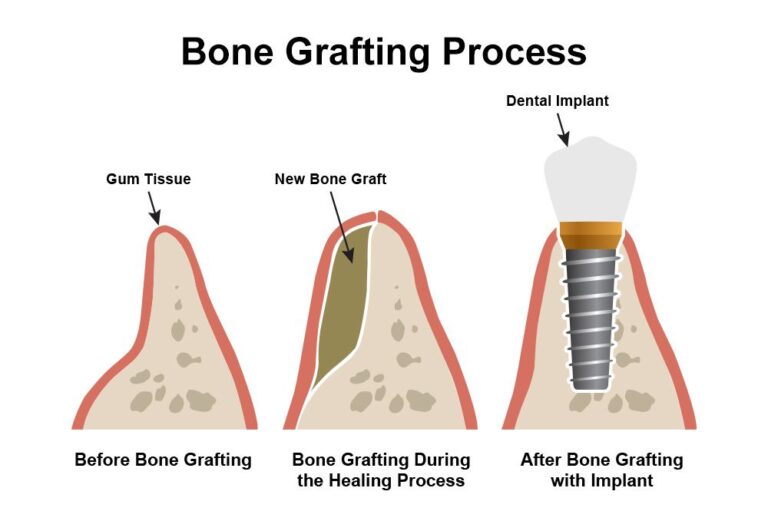
Tooth loss and bone loss can reduce the amount of jawbone available to support a dental implant. If there is not enough bone volume or density, bone grafting may be recommended to improve the foundation for implant placement.
What Is Bone Grafting?
Bone grafting is a dental procedure that uses natural or biocompatible bone grafting material to help restore lost bone volume and support new bone formation in the jaw.
After healing, the grafted area can provide a stronger foundation for dental implant placement, depending on your individual treatment needs and healing response.
When Is Bone Grafting Needed?
Bone grafting may be recommended when:
- Teeth have been missing for an extended period, resulting in jawbone loss
- After a tooth extraction, when preserving the remaining bone is recommended
- Gum disease has caused bone loss around the teeth
- There is insufficient bone to support a dental implant
- Additional bone support is needed to prepare the jaw for future implant placement
How Do I Care for My Dental Implants?
Good oral hygiene and regular dental visits help maintain the health of your dental implants and surrounding gums.
- Brush and floss daily
- Attend regular dental examinations and professional cleanings
- Keep the implant and surrounding gums clean
- Contact your dentist if you notice swelling, bleeding, discomfort, or implant mobility
Can Dental Implants Get Peri-Implantitis?
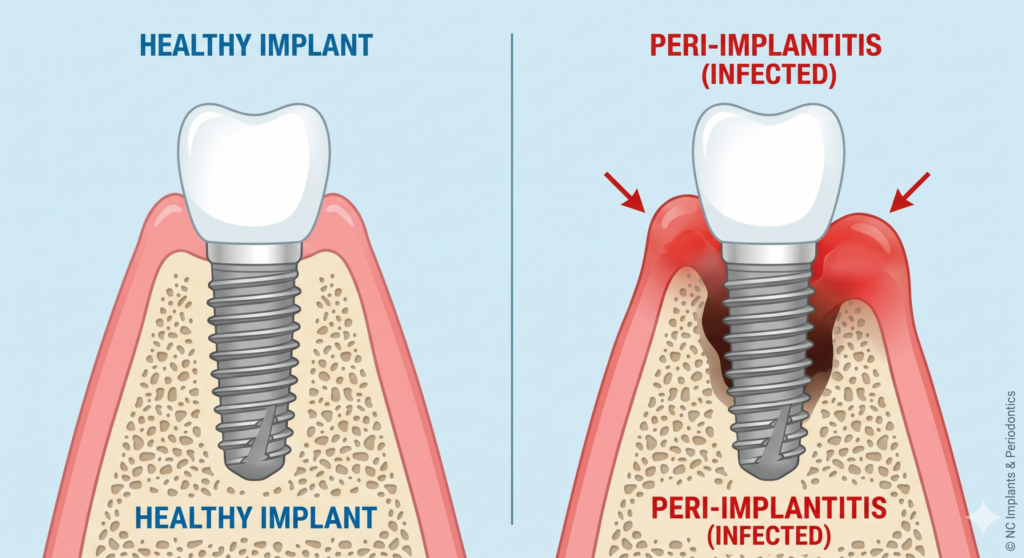
Dental implants cannot develop cavities, but the gums and supporting tissues around an implant can still become inflamed. Peri-implantitis is an inflammatory disease affecting the tissues around a dental implant and is typically associated with loss of supporting bone around the implant.
Common signs may include red, swollen, or bleeding gums around the implant, pain, or discomfort. In more advanced cases, the stability of the dental implant may also be affected.
Peri-Implantitis Treatment
Treatment for peri-implantitis depends on the condition of the tissues around the implant and the extent of bone loss. Depending on your individual needs, treatment may include professional cleaning, implant maintenance, and periodontal treatment.
If you notice any changes around your dental implant, it is important to have a dental examination and implant assessment. Your dentist will evaluate the gums, soft tissues, and supporting bone around the implant and recommend an appropriate treatment plan based on the findings.
For more complex cases, we may recommend referral to a dental specialist for further assessment and treatment.